
I’ve spent a lot of my life—especially since my late autism diagnosis—trying to build a world that feels “level”. But lately, that level has been tilting. I found myself becoming increasingly, and quite frankly, exhaustingly, emotionally dysregulated. When the overwhelm hits, it isn’t just a “bad day”; it’s a total system failure.
And so, after a lot of internal debating, I decided it was finally time to ask my GP for an ADHD assessment.
The Research Rabbit Hole: Am I a Fraud?
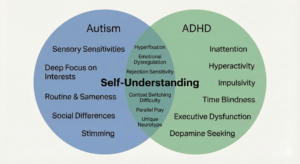
If you’ve read my previous posts, you’ll know I’ve been wrestling with this inner conflict for a while. Is it “just” the autism? Or is there something else at play? The two-week wait for my doctor’s appointment felt like a lifetime, and in true neurodivergent fashion, I immediately entered “full research mode”. I’m talking YouTube marathons, scouring forums, and reading every bit of clinical literature I could get hands on — it’s a special interest in itself, isn’t it?
But honestly, the research wasn’t just about data; it was about survival. I’ve been reflecting on my life through a new lens, trying to prove to myself that I wasn’t just… well, a fraud. We talk about imposter syndrome a lot, but for those of us who are late-diagnosed, there’s this constant, niggling fear that we’re overthinking things or “jumping on a trend”.
Re-examining Time, Sleep, and Special Interests
To feel justified in seeking an assessment, I had to re-examine everything. First, there was my relationship with time (which I now realise is more complex than I thought). Then, my sleep patterns, which I thought were fine but are actually a chaotic mess of late-night ideas. I’ve realised I’m not particularly healthy with it, either; I often stay up far too late just to feel like I finally have some quiet time to myself—a precious, solitary window before the cycle of work and the school run begins again all too early.
I also thought about the way I engage with my interests. I’ll be deeply into a hobby, then suddenly, the “newness” evaporates and I’m onto the next shiny thing. Looking back at my younger self, these traits were all there, hidden in plain sight. I wasn’t a fraud; I was just a person who had spent decades trying to navigate a world built for people whose brains don’t have twenty tabs open at once.
What is the “Right to Choose” Pathway for ADHD?
Now, if you are in the UK and considering this path, the “how” of it all can be incredibly daunting. For me, there is immense solace in the “pick-it-apart” phase of research, and one thing I’ve learned is that the Right to Choose (RTC) pathway is a vital tool.
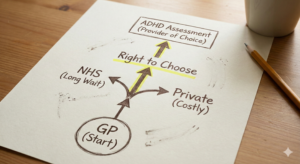
Essentially, under NHS England legislation, you have the right to choose which provider (you’ll need to research these) performs your specialist outpatient treatment. This is a game-changer for ADHD. Why? Because the standard NHS waiting lists can be years long—and while private assessments are faster, they are eye-wateringly expensive.
Why Choose RTC Over a Private Assessment?
More importantly, if you go purely private, getting your medication through the NHS later (via a shared-care agreement) can be a bureaucratic nightmare. The Right to Choose pathway is a middle ground; you are seen by a private provider, but it’s funded by the NHS, making that eventual “medication step” much less complicated.
It does take longer than a standard private route, but it’s more sustainable. I waited far longer than I should have to take this step; I’ve allowed myself to struggle in ways I shouldn’t have. If you’re reading this and nodding along… maybe this is your sign that it’s okay to ask for that referral.
The Day of the Appointment: Paralysis and RSD
When the day of the GP appointment finally arrived, I was a mess. I became totally “appointment paralysed”—that delightful state where you can’t do anything else because the upcoming event has taken up full occupancy in your brain.

I was so anxious. Rejection Sensitive Dysphoria (RSD)—that intense emotional pain related to the feeling of being rejected or criticised—was shouting in my ear that I was wasting the doctor’s time. I went in with copious notes (classic me), prepared for a fight.
Talking to the GP: Validation and Next Steps
But… he was lovely. He listened. He looked at my screener and asked me about my ability to watch a film. I told him the truth: I can watch a film, but never without doing something else—scrolling, drawing, or having my laptop on my knee—unless I’m in the sensory bubble of a cinema.
He smiled, looked at my notes, and agreed to the referral to the Right to Choose provider I’d identified. Coming away from that appointment, I felt happy, but I was also totally, utterly exhausted. It’s like all the adrenaline that had been keeping me upright just evaporated, leaving me to settle into the reality of what’s next.
Moving Toward an AuDHD Future
Being autistic means I don’t always love the idea of “disruption” or “change”, and yet, there’s a part of me (possibly ADHD?) that is genuinely excited. I’m excited to learn more about myself—to stop struggling so much and start integrating strategies that actually work for my specific brain.
Whether it’s dietary tweaks (keeping things vegan but ADHD-friendly!) or simply being kinder to myself when I lose focus, I’m finally moving toward a version of me that includes all parts of me. I’ve realised that I don’t need to wait for the formal paperwork to arrive to start living with an ADHD brain in mind; right now, I can begin validating those needs, giving myself permission to use the tools that help, and finally understanding why I’ve always needed that extra bit of stimulation to stay on track. If you’re on this path too, just know that your struggles are real, you aren’t a fraud, and you aren’t wasting anyone’s time. We’re just learning how to turn the lights on in a house we’ve lived in for a very long time.
Leave a Reply